
Water Usage Calculator
Most household water goes to a handful of uses — toilets, showers, laundry, faucets and, in summer, the garden. Enter how your household uses water and this calculator estimates the gallons (or litres) per day and month, what it costs, and how much you’d save with efficient fixtures.
- Free to use
- No sign-up
- Runs in your browser

Water usage calculator
Lawn watering
Home Water Use Tracker
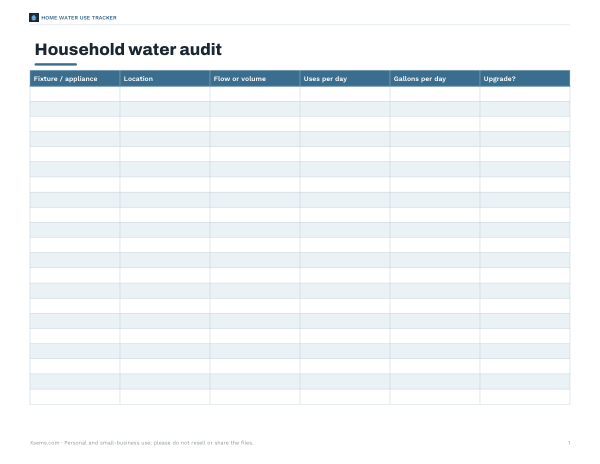
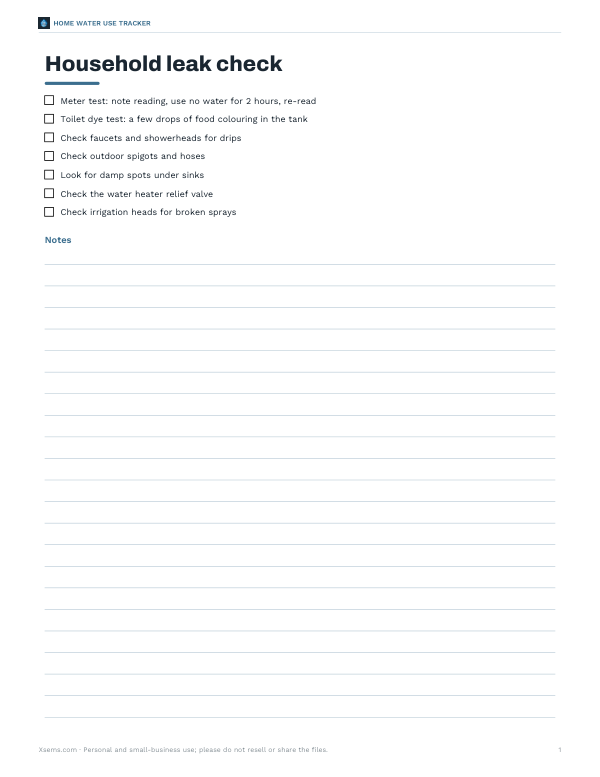
Household water audit worksheet, a monthly meter reading and bill tracker spreadsheet, a leak check checklist and a lawn watering schedule.
- Water audit (PDF/DOCX/XLSX)
- Meter tracker (XLSX)
- Leak checklist (PDF/DOCX)
- Watering schedule (PDF/DOCX)
Formats: PDF, DOCX, XLSX. Instant download after payment (link valid 72 hours, up to 5 downloads). AI-assisted: the templates were drafted with AI help and reviewed and laid out before publishing.
$3.00 USD, one-time 4 files · about $0.75 each
- Instant download
- 7-day refund
- Secure checkout by Stripe
7-day money-back guarantee. Full refund within 7 days of purchase, even after you download.
Free sample: Lawn Watering Schedule (PDF, 49 KB)
Full refund within 7 days — see the refund policy and license.
Free printables
Single sheets you can print right now, no sign-up. The full pack adds every sheet in one download plus the editable files.
 Printable Lawn Watering Schedule
Typical fixture flow rates
| Use | Typical rate | Notes |
|---|---|---|
| Showers | 2.5 gpm | Standard showerhead (US maximum 2.5 gpm); WaterSense ≤ 2.0 gpm |
| Baths | 36 gal each | A full tub often holds 30–50 gallons |
| Toilet flushes | 1.6 gal/flush | 1.6 gpf standard since the 1990s; older toilets 3.5+; WaterSense ≤ 1.28 |
| Bathroom faucet | 1.5 gpm | Aerated faucet; older faucets 2.2 gpm |
| Kitchen faucet | 2.2 gpm | US maximum 2.2 gpm |
| Dishwasher | 4 gal/load | Efficient models often 3–5 gal; older 10+ |
| Clothes washer | 20 gal/load | High-efficiency 15–25; older top-loaders 30–40 |
| Outdoor watering | 5 gpm (hose/sprinkler) | Varies widely by hose and sprinkler |
US federal standards cap showerheads at 2.5 gallons per minute and kitchen faucets at 2.2 gpm, and toilets sold today typically use 1.6 gallons per flush or less. EPA WaterSense-labelled products go further — for example showerheads of 2.0 gpm or less and toilets of 1.28 gpf or less.
How much water does a household use?
The US EPA’s WaterSense programme estimates that the average American uses about 82 gallons of water a day at home, and that more than half of household water use can go to outdoor watering in some regions during summer. Indoors, toilets, showers, faucets and clothes washers are the largest uses, with leaks adding a surprising amount in many homes. Your own use depends on household size, fixtures, climate and habits — the calculator lets you model yours.
Worked example
A household of three takes 8-minute showers with standard 2.5 gpm heads (60 gal/day), flushes 1.6-gallon toilets about 15 times a day (24 gal), uses bathroom and kitchen faucets (about 36 gal), runs the dishwasher five times and the washing machine five times a week (about 17 gal/day together), takes one bath a week and waters the garden for an hour a week. The calculator puts them at roughly 185 gallons a day. Switching to WaterSense showerheads and toilets, aerated faucets and a high-efficiency washer would save several hundred gallons a month.
Watering a lawn
| Lawn size | ½ in per week | 1 in per week | 1½ in per week |
|---|---|---|---|
| 500 sq ft | 156 gal | 312 gal | 467 gal |
| 1,000 sq ft | 312 gal | 623 gal | 935 gal |
| 2,000 sq ft | 623 gal | 1246 gal | 1869 gal |
| 5,000 sq ft | 1558 gal | 3115 gal | 4673 gal |
One inch of water over one square foot is about 0.623 gallons. Many lawns need roughly an inch a week in summer, including rain; local extension services give better figures for your grass and climate.
Ways to use less water
- Fix leaks — a running toilet can waste hundreds of gallons a day.
- Install WaterSense showerheads, faucet aerators and toilets.
- Run the dishwasher and washing machine only with full loads.
- Water the garden early in the morning and only when needed.
- Use mulch and drought-tolerant plants.
- Check your water meter with no water running to spot hidden leaks.
Litres and gallons
| Quantity | Equivalent |
|---|---|
| 1 US gallon | 3.785 litres |
| 1 litre | 0.264 US gallons |
| 1 imperial (UK) gallon | 4.546 litres |
| 1 cubic foot | 7.48 US gallons (28.3 L) |
| 1 CCF (100 ft³) | 748 US gallons |
| 1 cubic metre | 1,000 litres (264 US gallons) |
Outside the US, water use is usually measured in litres and cubic metres. Switch the calculator to litres to see results in metric.
Where the water goes indoors
Toilets are often the single largest indoor use in homes with older fixtures, followed by showers, faucets and clothes washers. Leaks are a hidden category: a dripping faucet or a toilet flapper that doesn’t seal can waste more water than a person uses in a day. Because showers use both water and energy for heating, shorter showers and efficient showerheads save on two bills at once.
Reading your water bill
Water bills often charge separately for water supplied and sewer (wastewater), sometimes with tiered rates that rise with use, plus fixed monthly charges. Bills may be in gallons, thousands of gallons, cubic feet or CCF (hundred cubic feet); one CCF is about 748 gallons. Enter your combined water and sewer rate per 1,000 gallons to estimate costs.
Privacy
All calculations run in your browser.
Frequently asked questions
How much water does the average person use per day?
The US EPA estimates about 82 gallons a day at home for the average American.
How much water does a shower use?
About 2.5 gallons per minute with a standard showerhead; 2.0 or less with WaterSense.
How much water does a toilet flush use?
About 1.6 gallons for most modern toilets; older ones use 3.5 or more.
How much water does a dishwasher use?
Efficient models often use 3–5 gallons per load.
What is a CCF?
100 cubic feet of water, about 748 gallons.
Can I use litres?
Yes — switch the results to litres.
How can I tell if I have a leak?
Read your meter, use no water for a couple of hours, then read it again; any change suggests a leak.
Does a dishwasher use less water than washing by hand?
An efficient, full dishwasher usually uses less water than washing the same dishes under a running tap.
How much water does a lawn need?
Often about an inch a week in summer including rain; about 0.62 gallons per square foot.
Do low-flow showerheads work well?
Modern WaterSense models are tested for spray force and coverage as well as flow.